

 LinkedIn
Your agency may still be charging a 2015 percentage for work Google no longer lets it do by hand. Line up the changes from close variants to AI Max, and the gap between the invoice and the job gets hard to ignore.
This is not an argument that Google Ads runs itself. It is an argument about which work still needs doing. Bids, match-type structures, ad assembly, channel selection and audience work have all shifted toward automation. The decisions that remain can matter more than ever. They are not the same hours your retainer was built to cover.
2012–2014: Exact match gets its first exceptions
Close variants began as an option in 2012. In 2014, Google applied them to exact and phrase match without an opt-out. A keyword that looked like a precise instruction could now match a query that was not precisely the keyword.
That sounds small until you consider what an account manager sold at the time: careful keyword selection, careful match-type separation, careful control over which search triggered which ad. Close variants did not erase that work overnight. They did change its premise. The keyword list was no longer the complete list of searches an advertiser had approved.
For practitioners, the first response was more scrutiny of search terms and negatives. Keep that shift in mind. It recurs throughout this timeline: Google takes on more of the matching, while the manager’s valuable work moves toward deciding what should not count.
2015: A $20,000-a-month account has a lot of handwork
Take a $20,000-a-month Search account as the baseline. I would build three or four campaigns split by match type, with exact, phrase and broad match modified in separate ad groups. Sometimes I would put one keyword in an ad group to control its bid and ad. Then came two or three Expanded Text Ads per group, written by hand.
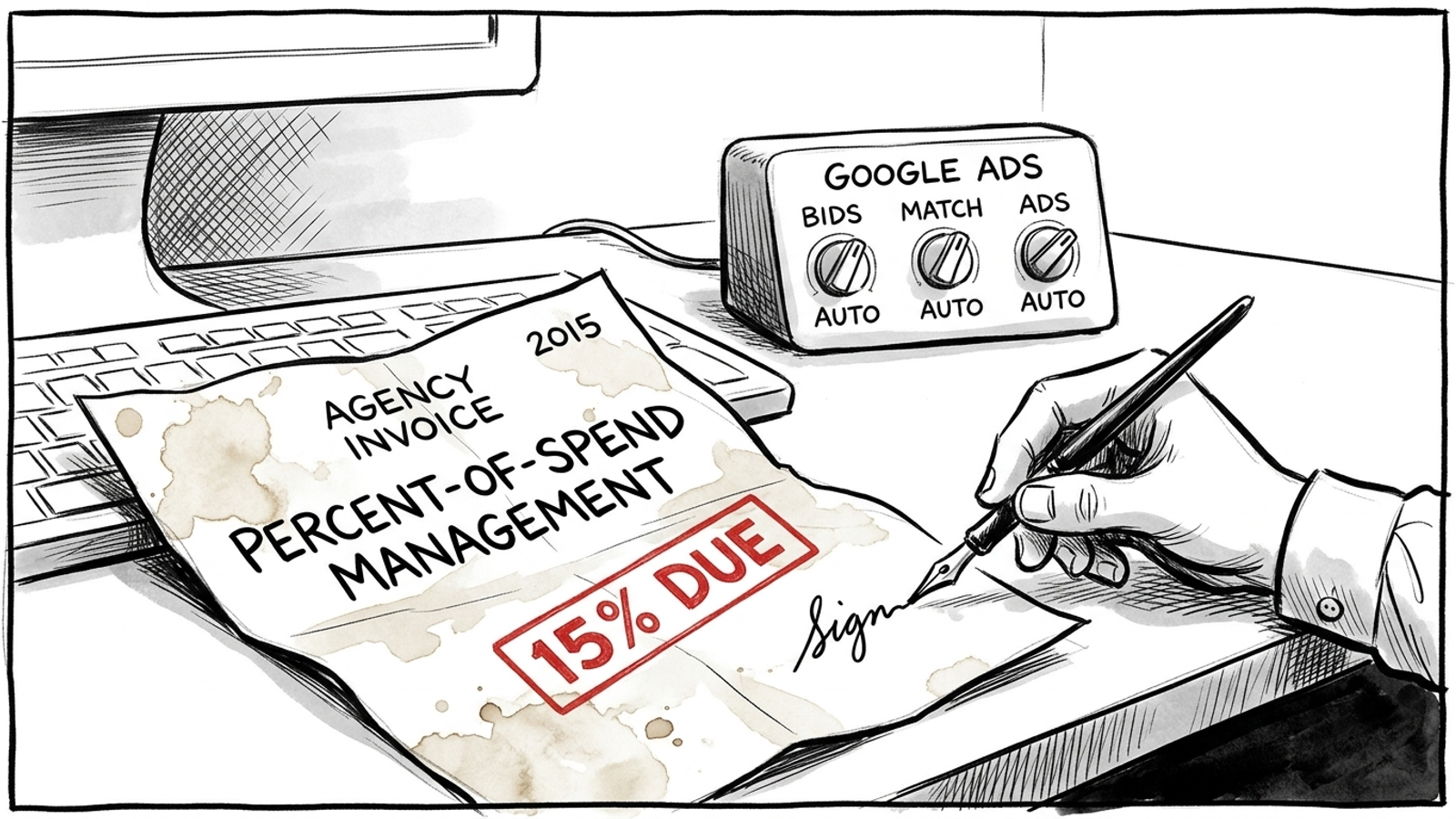
The recurring work had a rhythm: bid changes twice a week, search-term mining for negatives, and placement exclusions if Display was running. A mid-size account could take 8 to 12 hours a month of hands-on work. At a 15% management fee, that $20,000 account generated a $3,000 monthly invoice. The fee bought a substantial amount of building and maintenance, whether or not you liked the price.
That is the comparison point. When an agency says its fee has always been a percentage of spend, ask what the percentage bought then and what it buys now. The two lists should not be identical.
2016–2019: Smart Bidding takes over the bid sheet
Manual CPC made bid management visible. Open a report, change keyword bids, record the changes in a spreadsheet, repeat later in the week. Target CPA and Target ROAS moved more of that routine into the auction. Instead of a person setting one bid and waiting to revisit it, the system could set a bid for each auction using signals including device, location, time and query intent.
That is the mechanism behind the lost hours. A manager can still choose a target, check whether conversion tracking reflects the business, and intervene when performance goes off course. But those are different tasks from raising and lowering keyword bids twice a week. Routine bid changes stopped being a convincing centerpiece for a retainer.
I do not miss the bid spreadsheet. I do object to seeing its labor quietly remain on the invoice after the work moves elsewhere. If your manager says they manage bids, ask whether they mean setting the business objective or editing CPCs. Pay for the first answer, not a nostalgic description of the second.
2017–2021: Match types stop supporting the old architecture
Google kept widening the close-variant rules. In 2017, exact match began to disregard word order and function words. In September 2018, it expanded toward same-meaning paraphrases; in 2019, related changes reached phrase and broad match modified. Phrase absorbed broad match modified in February 2021, and new BMM keywords were no longer allowed from July. The close-variant timeline shows how many separate changes sit behind the phrase “exact isn’t exact anymore.”
I used to describe single-keyword ad groups as precision engineering. That description depended on a level of matching control that did not last. Once Google interprets what a keyword means, copying it across match types and hundreds of ad groups is less useful as a control system. It can become filing.
Broader matching also changes where the work goes. Queries can enter through rules the manager did not write, so negatives, conversion signals and the review of actual outcomes carry more weight. If someone still bills hours for elaborate match-type architecture, ask what that architecture controls today. A complicated account is not automatically a carefully managed one.
2021–2022: Performance Max folds channel work into one campaign
Google launched Performance Max globally on November 2, 2021. By September 2022, it had replaced Smart Shopping and Local campaigns. Performance Max could run across Search, Shopping, YouTube, Display, Discover, Gmail and Maps while handling bidding, targeting, creative selection and placement.
Before that shift, an ecommerce account might pay for separate Shopping, branded Search, non-branded Search, remarketing Display and YouTube builds. Each could bring its own budget decisions and bid rules. Performance Max did not make those channels disappear; it moved much of the channel-by-channel execution inside one campaign type.
What remains is not trivial. The feed and creative assets need attention. So do conversion signals and guardrails around product margins, brand and geography. The problem is charging separately for five sets of routine campaign maintenance when one automated campaign now performs much of it. Ask which line items describe decisions your manager makes and which describe decisions the machine makes.
2022: Responsive search ads take the assembly job
In July 2022, advertisers lost the ability to create or edit Expanded Text Ads, leaving responsive search ads as the Search text ad type. Google’s case for the change included its estimate that 15% of daily queries are new. Writing every possible headline combination by hand was not going to cover that inventory.
The machine now assembles ads from the assets you provide. That retires a familiar piece of account work: writing and testing several near-identical text ads per ad group, then calling the assembly process creative strategy. It does not retire copywriting. Someone still has to supply distinct, honest claims about prices, deadlines and differentiators. Those inputs determine what the system has to work with.
I would pay for someone who understands the offer well enough to write those inputs. I would not pay a recurring premium for manually arranging combinations the platform now arranges itself. Copy still matters; assembly is not the billable achievement.

2023–2024: Demand Gen replaces the Discovery routine
Demand Gen opened to all advertisers in October 2023. Google then upgraded remaining Discovery campaigns between January and March 2024. The Discovery-to-Demand-Gen change followed a familiar pattern: introduce a campaign type with more automated reach, then move the older campaigns into it.
Discovery had asked managers to define audiences and tend bids and placements. Demand Gen puts more emphasis on the creative, conversion goal and budget, with reach across YouTube Shorts, Discover and Gmail and Lookalike segments built through the platform. The manager’s job shifts from assembling audience menus to checking whether the goal and creative attract people the business can profitably serve.
That distinction matters on an invoice. “Audience management” could mean useful judgment about the customers you want. It could also mean adding in-market segments one by one because that is how the old workflow looked. Ask what the audience work changes, not how many settings someone touched. A menu is not a strategy.
2024–2025: Enhanced CPC loses its place in the middle
Google stopped offering Enhanced CPC for new Search and Display campaigns in October 2024 and moved remaining campaigns using it to Manual CPC in March 2025. Enhanced CPC had been a bridge between manual bids and more automated bidding. Its removal made that middle position harder to present as a lasting management method.
This does not mean every account must use the same bidding strategy. It means a manager should be able to explain the choice rather than point to occasional keyword-bid edits as proof of care. If the campaign uses Smart Bidding, the work is in the target and the data behind it. If it uses Manual CPC, ask why that choice serves the account and what the manual work achieves.
The bid sheet is no longer a service description. It is a tactic that needs a reason.
2025–2026: AI Max makes keywords less like orders
AI Max for Search entered open beta in May 2025, grouping text customization, campaign-level broad match, and brand inclusions and exclusions. Full API support followed in August 2025. The developer notes on the beta describe matching that reaches beyond the keyword list to URLs and creative.
With AI Max in use, keywords become less like a fixed set of instructions and more like one set of signals. Google can look for demand beyond the exact terms a manager entered. That makes the inputs around the keywords more consequential: which products carry margin, which pages convert, which queries should be excluded and what a qualified conversion is worth.
Give broad matching a soft form-fill goal and a loose set of pages, and it has little reason to distinguish valuable demand from easy volume. Give it a goal tied to the business and guardrails that rule out waste, and the search for volume has a better direction. The strategist’s job is to decide what demand counts, not to take credit for every query the system finds.
2026: The targets and defaults demand closer attention
Google planned to move Dynamic Search Ads into AI Max in September 2026, then pushed that migration to February 2027 after advertiser feedback about Q4 disruption. It restored DSA creation on June 15, 2026. At the same time, AI Max became the default for new Search campaigns after tests showed a faster first conversion. Put those developments together: the older campaign type got more time, but the default still pointed toward more machine matching.
On August 17, 2026, Google also made Target CPA and Target ROAS more directive for budget-limited Search, Shopping, Performance Max, Demand Gen and Travel campaigns. A $10 target delivering at $5 could trend toward $10 without an increase in spend. If a manager had treated the target as a loose ceiling, that habit now carried a different cost. The system treated the number more like an instruction.
This is where judgment earns its fee. A target is not a number to type into a field and forget. It tells the bidding system what outcome to pursue, while conversion values tell it which outcomes are worth more. Ask who chose the target, what business result it represents and when it gets reviewed. Those answers matter more than a tally of bid changes.
2026: The invoice still looks familiar
Here is the uncomfortable part. A small to mid-market agency can still quote $1,500 to $5,000 a month on retainer, or 10% to 20% of spend with a $1,000 to $3,000 minimum. Enterprise programs can run past $15,000 a month. Those agency pricing bands will not surprise anyone who bought management years ago.
Return to the $20,000-a-month account. At 15%, the monthly fee is $3,000. In the 2015 baseline, 8 to 12 hours of hands-on bids, builds, copy and mining sat behind it: roughly $250 to $375 per hour of that work. In 2026, bids can set themselves, matching reaches beyond the keyword list, responsive ads assemble from assets and Performance Max handles work across channels. The account still needs management. It does not need the old task list presented as if nothing changed.
Agencies will say automation demands a smarter strategist, so the retainer should stay. The first half is right. Bad tracking, the wrong target or a weak offer can send an automated campaign in exactly the wrong direction, faster. But that does not justify charging indefinitely for the build-and-babysit package automation replaced. Performance Max handles substantial execution while advertisers still have limited visibility into what drives results. That makes accountability more important, not a reason to invoice for invisible activity. It is the question behind why agency retainers never dropped.
Pay for decisions that change what the machine chases. That means the offer and landing page, guardrails around brand, margin and geography, and measurement clean enough to bid on. It means excluding queries and products that lose money and using qualified pipeline or closed revenue where the tracking supports it. What the deck calls full-service management should have to show which of those decisions it made. Otherwise, it is an expensive way to watch a dashboard.
Today, 2026: Demand proof over the next 90 days
The work moved from hands to judgment. Buy judgment, then make it prove itself. Before the next increase in spend, ask any manager, human or machine, to put three things in writing:
- A target tied to money. Use cost per qualified lead, cost per closed deal, or ROAS on margin-tracked revenue rather than clicks, impression share or raw leads. If you close 1 in 20 form fills and bidding rewards every fill equally, the system has no reason to prefer the ones that become customers.
- A 90-day window with a starting number. Record day-zero CPA or ROAS, what will change in weeks 1 to 4, and what you will judge on day 90. Learning periods are real; roughly 30 conversions in 30 days is a useful Smart Bidding reference point. It is not permission to replace a measurement plan with calendar excuses.
- An action log with reasons. Date every budget shift, target change, exclusion and creative swap, and give each one a line of explanation. If spend moves in Performance Max and nobody can explain the response, you have observation, not management. For the longer arc from Discovery through Demand Gen and Performance Max, read the consolidation story beside your last three invoices.
The next change will not bring the bid spreadsheet back. Keep paying a 2015 percentage for an unexamined list of tasks, and the timeline will keep moving while your invoice stands still. Stop buying the hours Google removed. Buy targets, guardrails and proof.