

 LinkedIn
The proposal says, “We only win when you win.” Page nine says the agency gets 15% of monthly ad spend, with a $3,500 minimum. That is a percentage-of-spend retainer wearing a nicer jacket: the manager earns more when you spend more, not when you sell more. I have seen founders sign deals like this convinced they bought an aligned partner. The test is less romantic: fix the fee and the performance target in writing before money moves, then spell out what happens if the target is missed.
Myth 1: “Percentage of ad spend is performance pricing”
People believe this because the pitch sounds reasonable on a discovery call. As the business grows, the ad budget grows; giving the agency a share of that budget appears to reward its contribution. But ad spend is an expense, not an outcome. PPC agencies pitch percentage-of-ad-spend fees between 15% and 20%. Those fees rise when you put more cash into Google Ads, whether that cash produces profitable customers or a costly lesson about the wrong keywords.
Here is how the agency gets a raise when your costs rise. Say you spend $20,000 a month to acquire 200 customers at a $100 cost per acquisition (CPA). At a 15% management fee, you pay the agency $3,000. Next quarter, auction costs climb or targeting drifts. CPA reaches $150, so keeping that 200-customer volume requires $30,000 in media spend. Your acquisition efficiency falls by a third. The agency’s fee rises 50%, to $4,500.
The manager may have worked hard throughout. That does not change the contract’s incentive. If you want to pay for performance, put acquisition efficiency, qualified pipeline, or attributable revenue in the agreement. Do not use the size of the media bill as a stand-in for success.
Myth 2: “A percentage of revenue aligns everyone”
A revenue share sounds closer to a partnership. Performance-fee models in ecommerce and DTC can charge 5% to 10% of attributed revenue, while another model takes 15% of revenue above a negotiated historical baseline. The agency gets paid when sales appear. What could be cleaner?
Attribution, for one thing. A sale attributed to an ad is not necessarily a sale the ad created. When compensation depends on gross attributed revenue, a manager has reason to capture existing demand rather than find new buyers. PPC practitioners describe how performance deals can deteriorate around branded bidding and attribution windows.
Imagine a repeat buyer searching your exact brand name to reorder a product they first found through organic search. Your ad appears above the organic result. They click it, check out, and the agency invoices you 8% of the order value. The click is real. So is the invoice. The hard question is whether the ad won you a customer you would otherwise have missed.
We have covered how agency fee structures create misaligned incentives. The revenue-share version deserves particular scrutiny because its headline metric looks like the one you actually care about. Before signing, define the baseline and decide whether branded search belongs in the calculation. Otherwise, you may pay a commission for standing beside the checkout register.
Myth 3: “A lead guarantee is a sales guarantee”
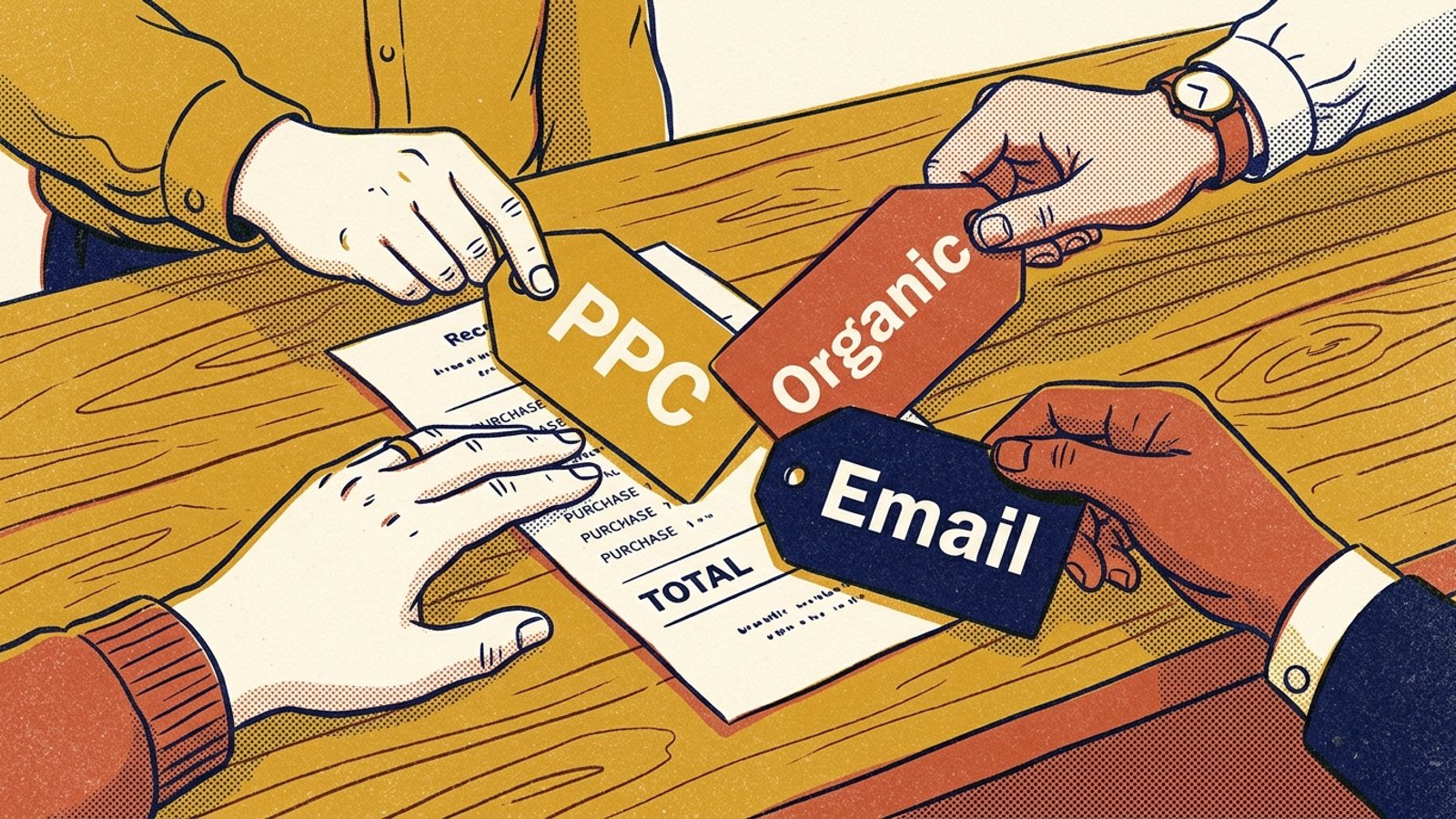
“We guarantee 50 qualified leads in 60 days or you don’t pay” has a comforting ring to it. The comfort lasts until you read the contract’s definition of qualified. As business owners buying pay-per-lead packages have found, a form submission and a customer are not the same thing.
If the contract rewards a count of forms, the manager can loosen keyword match types, promise discounts in the ad copy, and shorten the form. More names come in. Your sales team then gets to distinguish potential customers from student inquiries, wrong numbers, and competitors looking around. The agency met the number; you inherited the sorting job. Tie the guarantee to sales-accepted leads or qualified pipeline verified in your CRM, not whichever submissions are easiest to collect.
Myth 4: “Pay-on-results always costs more than a retainer”
Agencies defending retainers often frame the choice as a trade: pay a predictable monthly bill or let a performance partner take a huge share of the upside. There is some logic to the risk-premium argument. But it sets up a false choice between a traditional retainer of $2,500 to $6,000 for a boutique or $6,000 to $15,000 for a mid-market team and a commission that grows with revenue.
Run the same illustrative numbers across three spend levels. These are comparisons of fee structures, not forecasts for your account:
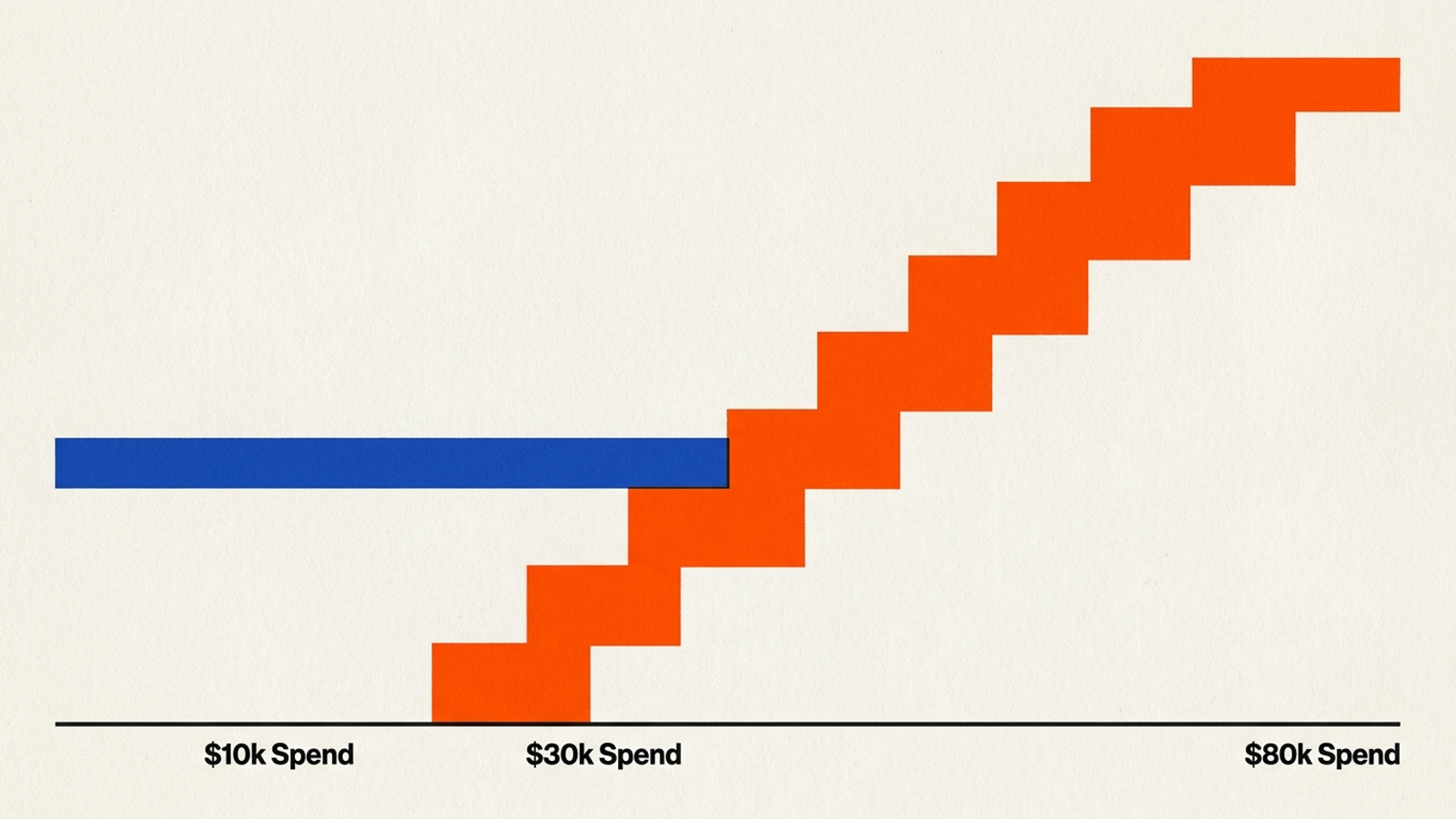
- At $10,000 a month in ad spend: A 15% spend fee is $1,500, though a $2,500 contract minimum would raise the bill. An 8% revenue cut on $30,000 in attributed sales is $2,400. A $3,500 boutique retainer costs more here, but the cheaper-looking percentage fees still leave you carrying the downside if ads underperform.
- At $30,000 a month: The 15% spend fee reaches $4,500. An 8% commission on $90,000 in attributed sales reaches $7,200. The illustrative $5,000 retainer stays put.
- At $80,000 a month: The spend fee is $12,000. An 8% share of $240,000 in attributed sales is $19,200. A larger media budget does not, by itself, mean the manager has to make proportionally more manual bid changes, search-term decisions, and negative-keyword updates once the account structure is stable.
The same distinction matters when buying tools. Some PPC automation platforms charge 2% to 5% of managed ad spend above fixed thresholds. A bigger software bill does not necessarily buy you more capability. If you are asking who charges based on CPA instead of spend, start by checking what the contract actually rewards.
A flat fee paired with a written acquisition target is the missing option in the usual pitch. The fee does not climb merely because you spend more, while the target gives you a concrete way to judge the work. Pricing alone cannot deliver a result. It can stop the provider from getting an automatic raise when efficiency slips.
Myth 5: “A flat fee means less effort”
I understand why this one sticks. If a manager earns the same amount at $60,000 in spend as at $10,000, why would they keep working? That question assumes effort still means a person making manual keyword adjustments in proportion to budget. It does not. Automated bidding and looser match types changed the work; an account spending six times as much does not require six times as many manual edits.
A flat fee can still buy indifferent management. The fee is not the proof; execution and the target are. A modern operator has to keep making changes, watch acquisition efficiency, and give the client a reason to stay. At groas, we run autonomous 90-day sprints for one flat fee, paid once up front, or offer $999-a-month white-label paid ads management for agencies. Execution runs 24/7 rather than waiting for the next account-manager login. Judge the work and the agreed outcome, not the number of hours someone can put on an invoice.
Myth 6: “You need 6 to 12 months to judge a Google Ads manager”
A long commitment can sound responsible. Search campaigns need data, and nobody should declare victory from three promising clicks on a Tuesday. But 6-to-12-month commitments are often justified as time for algorithms to mature, sometimes alongside guarantee clauses tied to accepting recommendations to increase spend. Those terms protect the agency’s billing schedule. They are not, by themselves, evidence that your account needs three calendar quarters before anyone can assess the work.

There are earlier signs to inspect:
- In week one, check measurement. Does conversion tracking capture genuine purchase intent, or does it inflate results with secondary page loads?
- By week three, check search terms. Are your match types reaching commercial buyers or spending on informational queries?
- By day 90, check the trend. If the account has accumulated enough conversion volume across multiple auction cycles, you can assess baseline CPA and movement in pipeline.
Smart Bidding needs conversion events to calibrate an auction baseline, not permission to send invoices indefinitely. A 90-day window is a full financial quarter. Ask for meaningful movement in acquisition efficiency or pipeline within that window, while accounting for whether the account has enough conversions to make the comparison useful. If targeting is wrong and execution is slow, another nine months on retainer will not cure either problem.
Myth 7: “If the target is missed, you just lose the money”
People believe this because many guarantees leave the buyer holding the expensive parts of the risk. As agency contract red-flag discussions note, conditions and credits can make a guarantee less valuable than its headline suggests. If a miss earns only a credit against a mandatory future retainer, you have still paid for the ad spend and management while waiting for a better result.
A miss clause must say what the provider does next. Write down the target before payment, along with the baseline, deadline, and consequence of falling short. At groas, the 90-day paid ads sprint sets a target of 40% more sales and leads, or we work for free. If the agreed target is missed at the end of the sprint, the autonomous engine and dedicated strategist keep running campaigns without another management bill until the benchmark is met. That is a concrete obligation, not a sympathetic slide about market volatility.
Read that obligation closely wherever you buy management. What counts toward the target? What happens on the day it is missed? A promise to discuss next steps is not a miss clause.
Myth 8: “You can manage a spend-based agency into acting like an owner”
This is the one I find hardest to kill. A founder spots the percentage fee and tells me it will be fine because they will watch the agency closely. I respect the instinct. Good oversight matters. But oversight cannot rewrite a fee formula. If keeping customer volume steady at a higher CPA requires more spend, the agency’s compensation still rises when your efficiency falls. You can question every budget recommendation and still be working against the contract’s incentive.
Before signing a deal described as performance-based, put three questions to the vendor in writing:
- “Does your management fee increase if my CPA rises?” If you must spend more to hold volume steady and the fee rises with that spend, you are paying a spend tax.
- “Are branded searches excluded from your revenue cut?” If not, ask how the contract distinguishes new demand from buyers already looking for you.
- “What happens when you miss the 90-day target?” Look for a defined consequence, such as a refund or continued management without another fee, rather than a review meeting or credit against more paid months.
You cannot persuade a percentage-of-spend contract to care about CPA. Fix the fee, agree on the target before money moves, and put the cost of missing it where the contract says it belongs.