

 LinkedIn
The question: do buyers see you, or did you get one lucky answer?
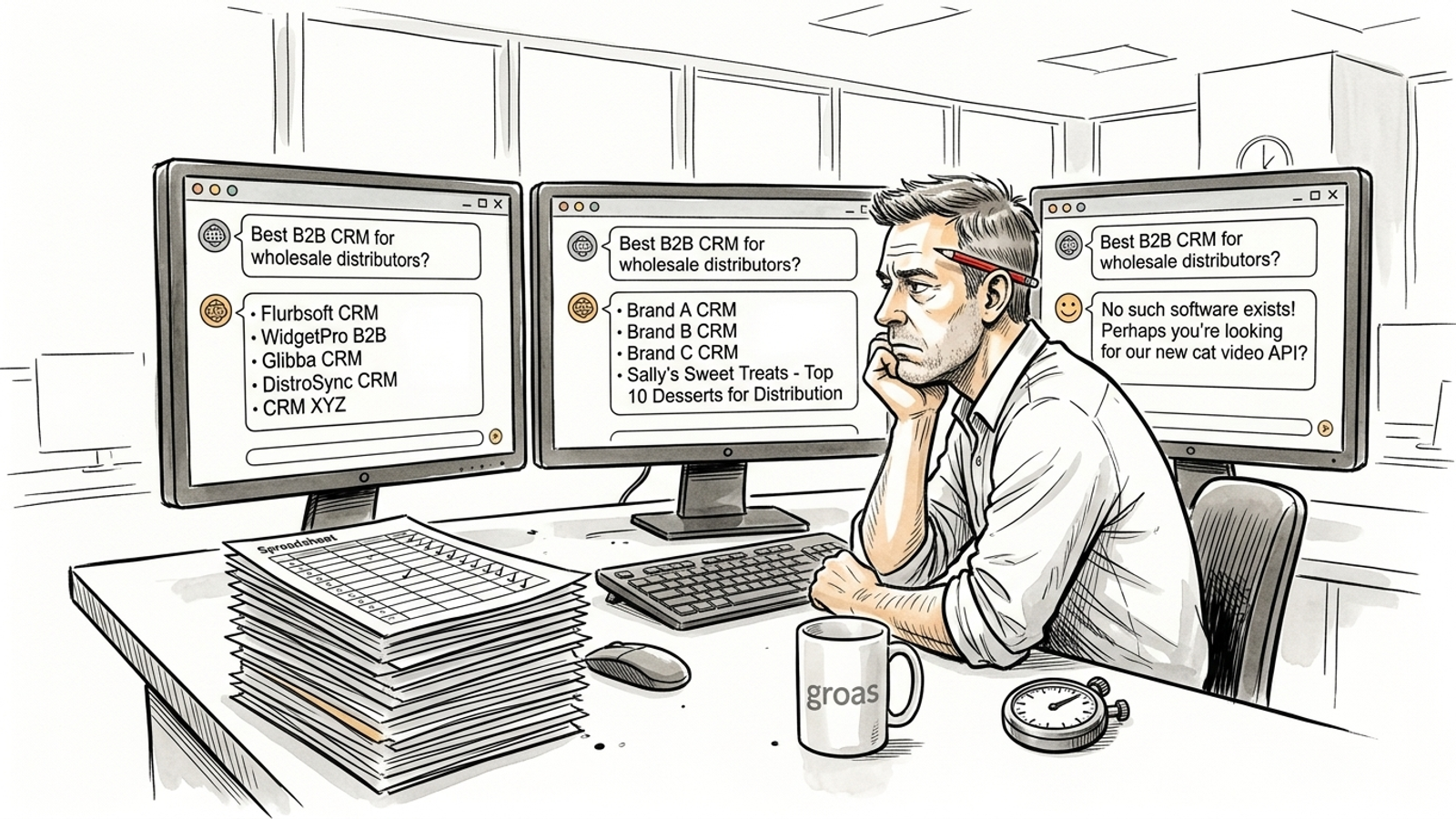
Ask ChatGPT for the best inventory software for independent bakeries, and your brand might appear. Ask again in a fresh session, and the shortlist may change. SparkToro and Gumshoe.ai tracked this across 2,961 runs: the odds of two identical prompt runs returning the same list of brands were under 1 in 100, and the odds of returning them in the same order were under 1 in 1,000.
One screenshot is not a visibility audit. It is the AI-search equivalent of running an ad for four minutes, recording one click and declaring the campaign structure solved.
I want a repeatable Share of Answer (SoA) score: how often an engine names your brand relative to two named competitors across a fixed set of commercial queries. I also want to know whether it links to your site or merely prints your name. That takes a prompt panel, clean sessions and a spreadsheet, not a triumphant Slack post about one favorable response. If you want to see how your business measures visibility across AI search, this is the baseline I would run first.
The protocol uses 30 buyer prompts, three passes and four environments: ChatGPT, Google Gemini, Perplexity and Google AI Overviews. That is 360 attempted prompt checks, plus a separate calibration prompt for each engine and pass. You can work through it in an afternoon. The result will not be a permanent ranking; it will be a baseline you can run again under the same rules.
Setup: fix the questions before you see the answers
Write 10 problem, 10 shortlist and 10 constraint prompts
Start with a fixed panel of 30 prompts a buyer might actually use. Skip ego queries such as “What is [Company Name]?” That tests whether an engine can find your identity, not whether it recommends you when a buyer has a problem and an open budget.
Split the panel into three buckets:
- 10 problem-aware prompts. Name the pain, not a vendor or software category. For example: “How do Shopify stores with over 5,000 SKUs handle daily inventory sync errors with QuickBooks?”
- 10 comparison and shortlist prompts. Ask for vendors or alternatives. For example: “Top five inventory management tools for high-volume multichannel retail” or “Best alternatives to Katana for custom manufacturing.”
- 10 brand-adjacent, constraint-specific prompts. Include requirements such as integrations, pricing constraints or workflow hooks. For example: “Inventory tracking software with native BigCommerce sync and flat monthly pricing.”
If you need candidates to adapt, use the 60 buyer questions prompt sheet. Write each final prompt exactly as you intend to run it. Once testing starts, do not improve the wording because you dislike an answer. That is how a control becomes a moving target.
Choose four environments and keep the session conditions steady
Run the panel in ChatGPT with web search active, Google Gemini, Perplexity and Google AI Overviews. They do not necessarily retrieve and present the same sources. An analysis of engine retrieval patterns found markedly different citation mixes for ChatGPT and Perplexity. Testing only one environment would hide differences that matter to your buyers.
Before the first prompt, write down your access method, location and date. Then hold the conditions steady:
- Use a fresh private window for each pass where the service permits it. Do not continue all three runs in one conversation.
- Log out of personal accounts when you can. If you must use a logged-in ChatGPT account, disable Memory and clear custom instructions so earlier conversations do not influence this test.
- Keep your browser and VPN location fixed. A switch from Chicago to Frankfurt halfway through is not a useful experimental variable.
- In Google Search, record whether an AI Overview actually appears. You cannot score a brand mention in an answer Google did not show.
Specialized monitoring software can spare you the data entry. AuthorityTech’s platform review lists Peec AI at $95 a month for 50 tracked prompts and discusses higher-priced enterprise tooling. Before paying for a dashboard, though, I would run this panel by hand once. Manual work makes the session quirks and citation displays hard to miss.
Name the competitors and add a calibration prompt
Track two direct competitors alongside your brand on every prompt: one established category incumbent and one peer closer to your size. Name them before you run the test. If an answer names no vendor at all, that is different from naming both competitors and omitting you. The comparison only works if you resist picking easier competitors after seeing the results.
Add a 31st, separate calibration prompt: a question so closely tied to your stated positioning that you would expect your brand to appear. For an autonomous ads product, that might be: “Who built the autonomous Google Ads engine that operates on flat monthly pricing without percentage fees?” Run it once per pass in each environment, but keep it out of the 30-prompt score. It is deliberately favorable to you.
If the calibration prompt repeatedly misses your brand, inspect the answer and its sources before blaming competition. Your positioning may be unclear to that engine, its retrieval may have missed your pages, or the prompt may not be as distinctive as you thought. One miss cannot identify the cause.
Run three separate passes, then log the answers
Give variation room to show itself
Run prompts 1 through 30 once per environment. Close the session, start a fresh one under the same conditions and repeat for pass two. Do the same for pass three. That gives you 90 attempted checks per environment. Run the calibration prompt in each pass as well.
Three runs are a practical screen for volatility, not a statistically settled estimate of future visibility. If your brand appears three times, record three mentions; do not call the association “locked in.” If it appears once, you have seen an unstable result worth tracking, not proof of a particular retrieval threshold. The point is to stop treating one response as the whole market.
Build a sheet that separates a name from a link
Set up seven core fields before testing. Use one row per attempted check, and keep the underlying response or a screenshot available for ambiguous cases:
- Prompt ID and category: Number 1 to 30; Problem, Comparison or Brand-Adjacent. Label calibration rows separately.
- Environment and pass: ChatGPT, Gemini, Perplexity or AI Overviews; pass 1, 2 or 3.
- Mentioned: Did your brand appear in the answer body? Record 1 or 0.
- Owned-domain citation: Did the answer include a clickable citation to your domain? Record 1 or 0.
- Position: First option, third option, unranked mention or not applicable.
- Competitors named: Record a separate 1 or 0 for each of the two preselected competitors.
- Source type cited: Owned domain, Wikipedia, Reddit, editorial affiliate list, industry forum or another identifiable type, where a citation appears.
For an AI Overview that does not appear, mark the check “not shown,” not zero mentions. Keep it in the attempt log but exclude it from that environment’s answer-based denominator. Otherwise you will mix two questions: whether Google displayed an Overview and whether your brand appeared inside one.
Columns 3 and 4 answer different questions. A brand can be recommended without a link to its site. A brand-monitoring discussion of ChatGPT and Perplexity describes how many mentions lack clickable citations. Analytics referral reports therefore cannot stand in for reading the answer. Log the printed name and the linked domain separately.
Score the baseline without pretending it is a census
After the three passes, calculate these metrics per environment, using answers that appeared and could be scored:
- Absolute mention rate: Runs mentioning your brand divided by scored runs. If 45 of 90 answers mention you, that rate is 50%.
- Share of Answer: Your mentions divided by the combined mentions for you and your two named competitors, multiplied by 100:
Your mentions / (Your mentions + Competitor A mentions + Competitor B mentions) × 100. Each brand can score a mention in the same answer. This is share among the three brands you chose, not a percentage of all possible vendors. The Share of Model calculation offers more context for that kind of comparison. - Owned-domain citation rate: Answers linking to your domain divided by answers mentioning your brand. If you are mentioned 30 times and linked 6 times, the rate is 20%.
Calculate mention rate by prompt category too. A weak problem-prompt result and a strong shortlist result tell a different story from zero mentions in both. Compare the same prompts, competitors and scoring rules when you repeat the test. A prettier spreadsheet will not rescue a changed denominator.
Read three patterns, then check the mechanism
Mentioned but not linked: inspect what the engine cites
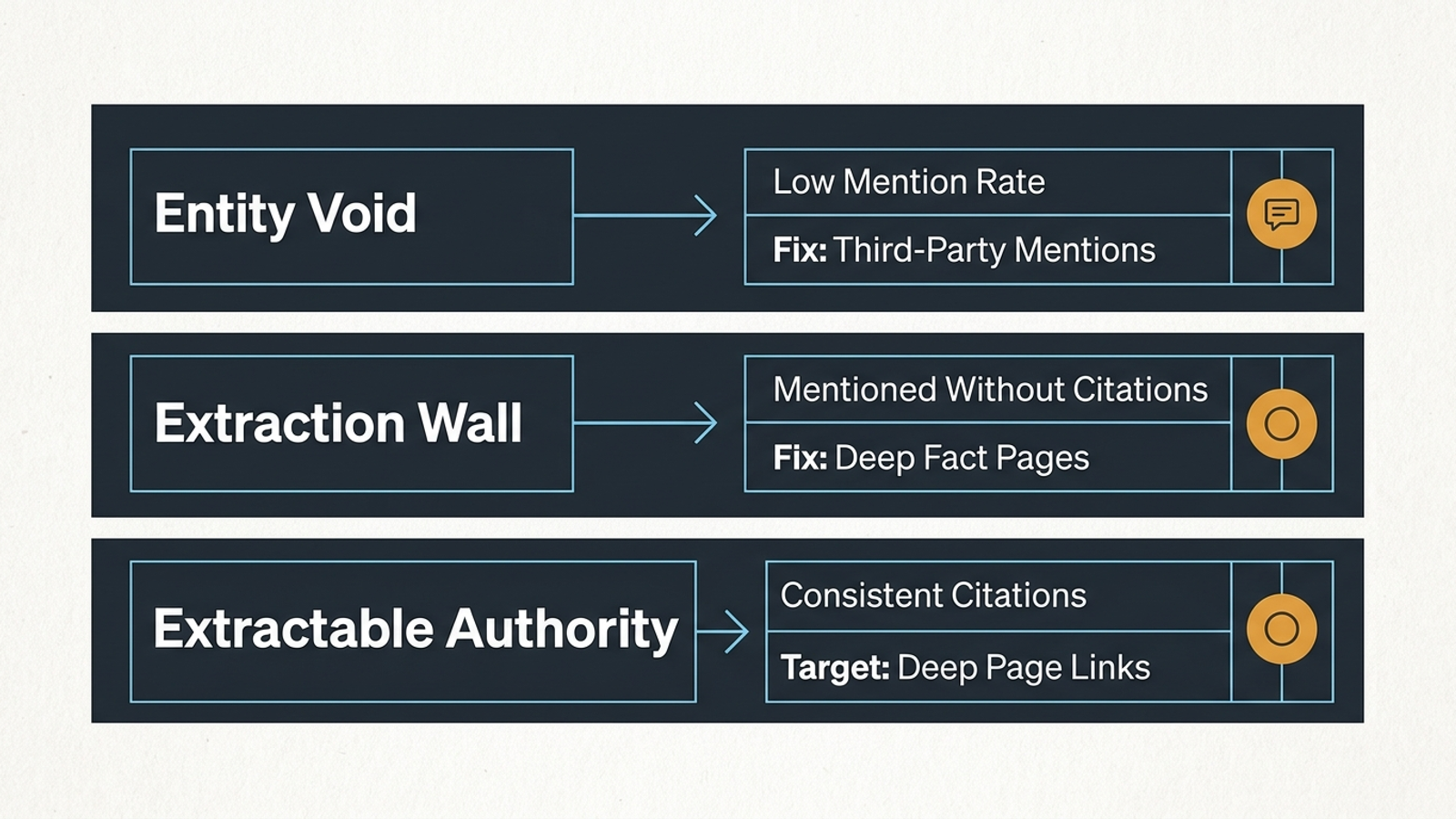
Suppose an engine names your product repeatedly but cites an affiliate review or directory instead of your site. Your name is getting into the answer; your domain is not earning the link. Inspect the cited page and your corresponding page. Does yours answer that prompt directly, or does it make readers dig through broad promotional copy?
A BrightEdge analysis reported that 82.5% of Google AI Overview citations went to deeper content pages, two or more clicks from the homepage. That result is a reason to examine relevant documentation, pricing details and specific comparison pages before polishing the homepage again. It does not prove that any one missing link is a formatting failure.
Absent while competitors appear: check category evidence
If your brand is absent across the problem and shortlist prompts while the two competitors repeatedly appear, do not start with a meta-description rewrite. Look at the answers and their sources. Do independent category pages, discussions or technical references describe your product in the terms buyers used? Do your own pages state its relevant specifications plainly?
The expectation is straightforward: if the sources an engine uses consistently establish competitors as answers to these questions but rarely establish you, the engine has less reason to name you. Publishing verifiable specifications and appearing in relevant category discussions may be more useful than another round of cosmetic copy edits. Treat that as a hypothesis to test on the next pass, not a verdict delivered by three runs.
Visible on one engine only: keep the fixes separate
If Perplexity repeatedly cites you and ChatGPT does not, preserve that difference in the report. Do not average it into a single “AI visibility” score and prescribe the same fix everywhere. Inspect what each engine showed, what it cited and which prompt categories produced the gap.
Google AI Overviews deserves its own read as well. BrightEdge’s longitudinal research reported that 54.5% of AI Overview citations came from organically ranking pages, but only 16.7% came from the organic top 10. A position-one ranking is not the only possible route to a citation. Separately, LLMRanks’ citation research found a stronger correlation between unlinked brand mentions and generative visibility than between traditional backlinks and that visibility. Neither finding tells you exactly why your brand missed a particular answer. Your logged sources are where that investigation starts.
Repeat the test without changing the test
The manual run gives you a baseline. Repeating hundreds of checks by hand every week gives you a second job, and I have done enough spreadsheet work to know that “just one more tab” is rarely the cure.
Keep the 30 prompt definitions unchanged for at least 90 days. If you reword a question every time the result annoys you, you lose the comparison you built. You can keep five additional qualitative prompts for manual spot-checks, but do not quietly fold them into the scored panel.
A lightweight script can help with repeat runs for services that provide suitable APIs. Our guide to building a weekly AI brand monitor with Google Sheets and three APIs covers a setup using OpenAI, Google AI Studio and Perplexity. Log its costs and settings. More importantly, do not treat an API response as interchangeable with a live search interface. Keep Google AI Overviews checks manual, and establish a new baseline if you change how any environment is queried.
Decide what either result changes
If your brand appears reliably across the buyer prompts, keep the panel running and look harder at the answers that mention you without citing your domain. If competitors dominate, the baseline tells you which prompt categories and environments deserve work first. If every answer is generic, revise your assumptions about those queries before buying a campaign to fix a gap the test has not found.
A spreadsheet diagnoses the gap; it does not publish a clearer technical page or fix a crawl blocker. That is where I would rather put the ongoing work than pay for another report about missing mentions. We built groas as a fully autonomous growth engine for paid and organic search: specialized models execute continuously within defined guardrails, while a human strategist owns direction and accountability. Unlike a dashboard that leaves the next action with you, the point is to act on the gaps the measurement exposes.
Run the panel. Keep the controls. Whether your brand wins or loses, let repeated buyer answers change the work you do next—not one flattering screenshot.